Sanders & technique · 2 min read
Sandpaper for orbital sanders: size, grit and how it differs from a random orbital sander
A rectangular pad instead of a round disc: which size fits, hook-and-loop or clamp, which grits – and when a random orbital sander is the better choice.
Last updated:
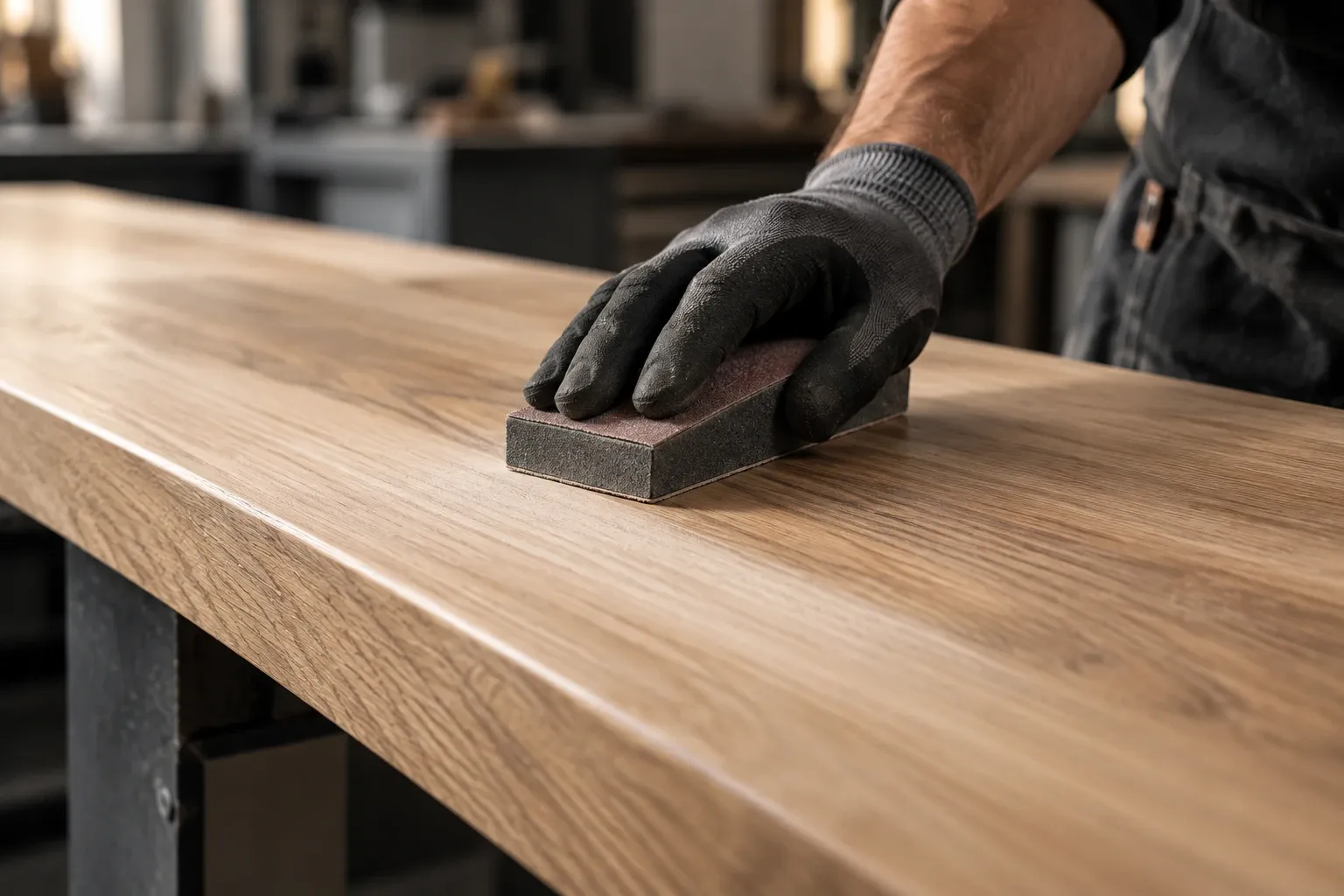
What makes an orbital sander
The rectangular pad oscillates in a small orbit but doesn’t rotate. It removes less than a random orbital sander, but it reaches right up to edges and into inside corners – window frames, door panels, the sides of furniture. You sand with rectangular pieces instead of round discs, so the first question is the size.
Which size fits
The pad size is given in the manual or on the machine. Many sizes derive from the 230 × 280 mm sanding sheet: half sheet 115 × 280 mm, third sheet 93 × 230 mm, quarter sheet 115 × 140 mm; some machines have their own dimensions. The paper must cover the pad completely but must not overhang at the sides – otherwise it flaps and tears.
Hook-and-loop or clamp
On hook-and-loop pads, the abrasive needs a hook-and-loop backing and a hole pattern that matches the extraction. PRO STRIP 70 × 420 has hook-and-loop and 14 holes and can be cut to length – check on one strip whether the holes then sit over those of your pad.
Clamp pads hold paper without hook-and-loop under spring clips. The roll suits these: PRO ROLL is 115 mm wide; you cut off the length and punch the extraction holes with the perforating plate that comes with many machines. Fine grits from P400 come as a 230 × 280 mm sheet (PRO SHEET) to cut to size – but with an electric machine, sand dry only.
Which grit
For wood, the usual sequence: P80 against saw marks, P120 to smooth, P180 before oil and stain, P240 before paint. Key old paint with P120 to P180 before repainting; between two coats of paint, P320 to P400. A last pass with the hand block along the grain takes out the fine swirls the machine leaves.
Orbital or random orbital sander?
The random orbital sander rotates and oscillates at the same time and is much faster on large surfaces. The orbital sander is for edges, corners, frames and light removal. Which abrasive belongs on a random orbital sander and which stroke suits which job is covered in separate articles. KORNDEX doesn’t stock triangular sheets for delta sanders or belts for belt sanders.
FAQ
Can I cut ordinary sanding sheets to fit an orbital sander?
Yes, if the size fits: divide a 230 × 280 mm sheet into halves, thirds or quarters and clamp it taut. On a hook-and-loop pad the paper needs a hook-and-loop backing, otherwise it won’t hold.
Why does the paper tear at the corners?
Usually it overhangs the pad or is clamped too loosely. Cut it flush, clamp it taut and don’t run the edge of the pad into edges and trims.
Do I need sandpaper with holes?
For extraction, yes. Without holes the dust stays under the pad, the paper clogs and cuts worse. Punch clamp paper with the machine’s perforating plate; hook-and-loop strips need a matching hole pattern.
Terms in this article
- Hole pattern
- Dust extraction
- Scuff sanding (keying)
- Swirl marks
- Orbital sander
- Orbit (stroke)
- Delta sander
- Belt sander
The whole sequence at once
4 grits, 1 × smallest pack each: PRO STRIP 70 × 420 (25 pcs) P80 · P120 · P180 · P240.
incl. VAT, plus shipping